
Speed to lead for Realtors usually gets treated as one problem: a slow callback. In practice your leads die in four places, and only one of them is about how fast you call back.
A lead comes in at 9:40 on a Tuesday night. Nobody answers. They don’t leave a voicemail either, because almost nobody does anymore. They just hang up and call the next name on their list.
That lead never shows up in your CRM. It never shows up in a report. You paid for it anyway, the ad spend, the portal fee, the lead list, all of it gone the moment the call disconnected. You’ll never know it happened unless you go looking.
That’s the part most advice on speed to lead for Realtors skips. It talks about speed like the only problem is a slow callback. The slow callback is real and it costs you deals, but it’s one leak out of four, and the other three are quieter.
The speed to lead for Realtors numbers that should worry you
There’s a well-documented study from InsideSales.com and MIT Sloan professor James Oldroyd that’s become the baseline for this entire conversation. The researchers tracked over 15,000 leads and more than 100,000 call attempts across six companies.
Their finding: the odds of actually reaching a lead who submitted a form drop by 100 times when you wait 30 minutes instead of 5. The odds of qualifying that lead, meaning getting them to a real conversation about timeline and budget, drop by 21 times over that same window.
Not double. Not five times worse. 21 times.
Velocify’s commonly cited figure puts a number on the first minute: replying inside 60 seconds can lift conversion by around 391%.
I’ll be honest about this one, because almost nobody else is. I checked seven sites that cite it. All of them name Velocify and none of them link to an original report.
So treat it as a widely cited industry figure, not something I could verify line by line. It points the same way as everything else here.
Here’s what I will stand behind completely, because I went and checked it myself: real estate response times are nowhere close to five minutes, and the gap between what agencies think they’re doing and what they’re actually doing is bigger than most owners want to admit.
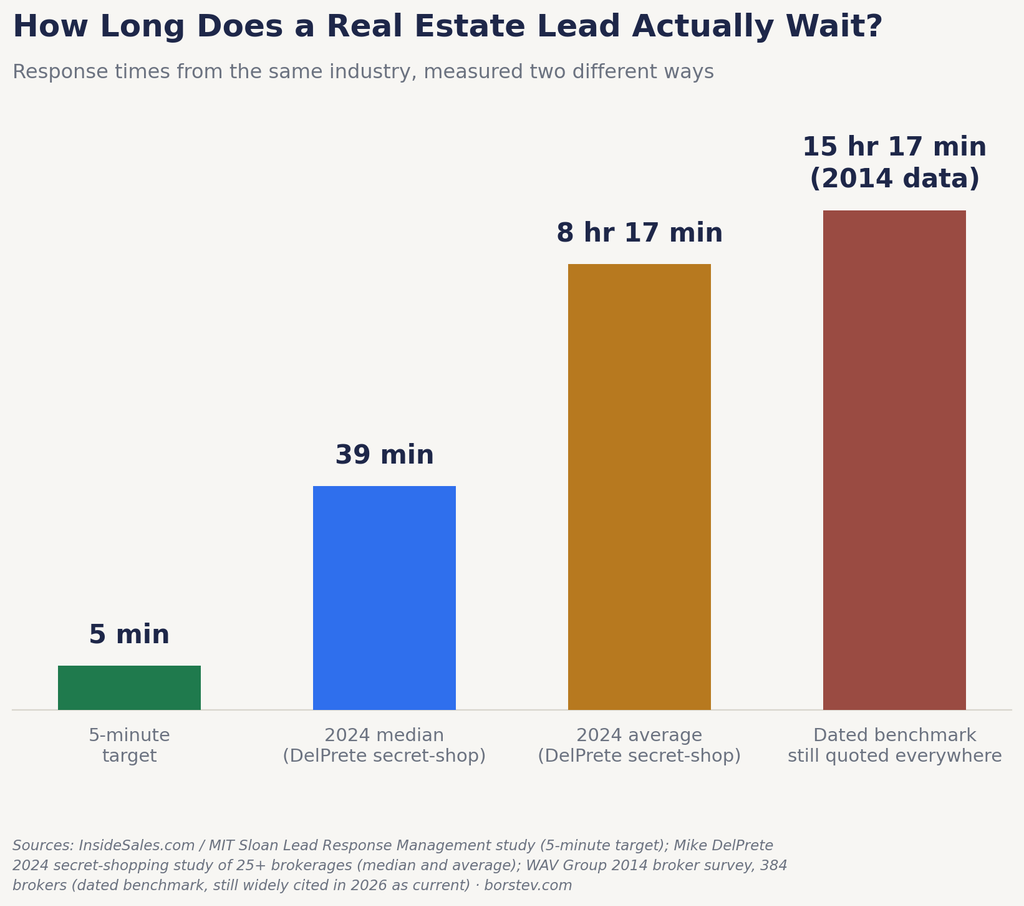
Mike DelPrete’s 2024 secret-shopping study sent real inquiries to more than 25 brokerages and timed what came back. The median response time was 39 minutes. The average was 8 hours 17 minutes.
That gap between median and average tells you something important on its own: most agencies are reasonably close to okay, and a smaller group that never responds at all is dragging the average into the ground.
There’s an older number you’ll see everywhere too, 15 hours 17 minutes, sometimes written as 917 minutes. That traces back to a 2014 WAV Group survey of 384 brokers.
It’s real data, it’s just over a decade old, and a handful of 2026 blog posts have started citing it as if it came from a fresh 2025 survey.
It didn’t. I’m including it here because it’s still useful context, not because it’s current.
Whichever number you look at, the case for speed to lead for Realtors comes down to one line. If you’re measuring your response time in hours, you are not competing for that lead. You’re hoping.
Place one: the invisible loss
This is the leak everyone admits exists and almost nobody fixes.
Showings run late. Closings run late. Your leads don’t run on your schedule, they shop at nine at night because that’s the twenty minutes they have after the kids are asleep to think about the biggest purchase of their life.
So the call comes in after hours. Nobody picks up. The lead doesn’t leave a voicemail, because most people simply don’t anymore, they hang up and call the next agent on their list. Nothing beeps. Nothing shows up on a report at the end of the month.
Here’s what makes this leak more expensive than a dropped call that still shows up in your CRM. A lead who goes cold in your system at least exists. You can see the name, the date, you can go back and try again.
A lead who hung up before a human ever answered never entered your business at all. When you sit down at month end and ask why the numbers are low, the answer isn’t in the CRM you’re staring at. It’s in the calls that never got logged anywhere.
You paid for that lead regardless. The ad spend, the portal connection fee, the list cost, all of it left your account whether or not a human being ever spoke to the person on the other end.
You’re not losing a lead you never had. You’re losing one you already bought.
We tested this ourselves by calling 147 offices, and the cheapest way to stop that loss is a missed call text back for real estate offices that texts every caller you couldn’t answer.
Place two: the moments you’re doing your actual job
You’re walking a buyer through a kitchen. Your phone’s in your pocket on silent, because that’s the professional thing to do, the person in front of you deserves your full attention. Meanwhile a different lead is calling, and you’re effectively being penalized for doing your job well.
The usual fix agents try is just checking the phone more between showings. That works for about two weeks. Then a week shows up with four showings, a closing and a listing appointment, and you’re back where you started, except now there’s guilt attached to it too.
Nobody in this business loses deals because they’re lazy. You lose them because you’re one person, in one place, with one phone, and a lead’s timing isn’t up to you.
That’s an architecture problem. And it’s where speed to lead for Realtors stops being a phone habit and becomes a system you build once.
There’s a second cost here that rarely gets discussed. Every time you take a call mid-appointment, the buyer standing in front of you learns your attention can be pulled away at any moment.
You end up losing on both ends at once: either the lead on the phone gets ignored, or the person who’s about to sign does.
Place three: the follow-up drift
This leak is quiet, which is exactly what makes it dangerous. Follow-up is the half of speed to lead for Realtors that nobody ever times.
I want to flag something directly here, because it matters for how much you trust the rest of this article. You’ll see a statistic everywhere in sales and marketing content claiming that 80% of sales require five or more follow-up attempts, usually credited to something called the “National Sales Executive Association.”
A VentureBeat investigation tried to trace that organization and couldn’t find it anywhere, not in a basic search, not in Better Business Bureau records, not in nonprofit registries.
The reporter’s conclusion was blunt: the number appears to be made up. I’m not going to repeat it here as fact, and if you’ve seen it in other content from me or anyone else in this space, it’s worth knowing it doesn’t hold up.
What does hold up, from research with a named author and a disclosed method: DelPrete’s 2024 study found that 62% of open house visitors got no follow-up at all after touring a home they’d physically walked through.
Not a cold internet lead. Someone who showed up in person, looked around, and then never heard from the agency again.
The pattern I see inside agency CRMs is consistent with that. Follow-up tends to stop around attempt one or two, usually because attempt one didn’t get a reply and the agent moved on to the next fresh lead.
But look at what’s actually happening by attempt three. Attempt one lands right after the form submission, when you’re still a stranger and they barely remember filling it out. Attempt two, they’re comparing you to two other agents and they’re busy at work.
Attempt three is when they finally have a real question they can’t answer themselves. If nobody’s there for that one, you’ve lost a genuinely warm buyer who now assumes you forgot about them.
This is also where follow-up gets confused with spam, and the difference matters. Five follow-ups doesn’t mean five “just checking in” texts.
It means five different reasons to talk: the answer to the question they asked, a new listing matching what they told you they needed, a market update on their actual neighborhood, a note that pre-approval takes longer than people expect, a genuine offer to help.
Same intent, five different doors. Anything else is just noise, and it’s a big part of why nobody wants to leave you a voicemail in the first place.
For the full Day 0 to Day 90 schedule with word-for-word texts, see this real estate lead follow-up system.
Place four: the handoff, and the one that kills your best leads
Say you’ve already fixed the speed problem. You reply in thirty seconds. This is where speed to lead for Realtors still goes wrong, even for agencies that are fast.
The buyer wrote in their form that they have a dog and need a fenced yard. Your fast reply says: “Thanks for reaching out, when would you like to see the property?” No mention of the dog.
No mention of the fence. Not one word proving anyone actually read what they wrote. The buyer’s reaction is predictable: I just told you what I need. Did anyone even look at this?
That’s a context problem, not a speed problem. The lead’s information is scattered across your CRM, a form, a text thread, an email, somebody’s handwritten notes from a call, and whatever answers the call is replying from can’t see any of it.
The buyer gets a fast answer that proves, just as clearly as a slow one would, that nobody actually read what they sent.
This is expensive for a specific reason. A lead who gets a generic fast reply doesn’t just get annoyed, they quietly downgrade you from “my agent” to “one of the agencies I’m talking to.” You did the hard part, you were fast, and then you spent that advantage on a reply that erased it.
It’s also why plenty of agencies try AI follow-up, run it for a month, and quietly turn it off. The tool wasn’t slow and it wasn’t careless. It just couldn’t see the conversation history, the prior calls, or the notes from the last showing, the exact gap we broke down in the CRM cleanup article.
Whatever’s sitting on top of a messy database inherits the mess.
Speed buys you the first five minutes. Context is what buys you the second conversation.
Even a fast, thoughtful reply can fail if it lands in spam, which is exactly what I found in my email deliverability for Realtors test of 44 agencies.
What speed to lead for Realtors actually looks like when it’s automated
The phrase gets thrown around constantly, and most people mean something different by it than what it actually does. It is not a robot voice cold-calling your leads at nine at night.
Nobody wants that, and that isn’t the product. What it actually is, is five things running underneath your business while you’re at a showing or asleep.
An instant first response. The moment a lead comes in, they get something back within seconds, not a canned auto-reply, an acknowledgment that uses their name and references what they actually asked about. That’s the difference between a form confirmation and the start of a conversation.
Coverage for the missed call. This is the fix for place one. The call you couldn’t take gets picked up by an AI receptionist that already knows your listings and your process, gathers what it needs, and hands you a prepared summary instead of a blank voicemail.
Qualification. It asks the two or three questions you’d ask anyway, timeline, budget, pre-approved or not, so that when you call back you’re not opening cold.
Booking straight into your calendar. The lead picks a slot, it lands on your calendar, no phone tag and no “let me check and get back to you.”
Follow-up sequencing. The five touches spread across days and weeks, each one with a different reason to talk, running whether or not anyone remembered to do it manually.
Here’s the honest part, the same one worth saying about any automation. None of this fixes a broken process, it runs on top of whatever process you already have.
If your follow-up rules were never written down, speed to lead automation just makes the chaos faster, and you’ve paid extra for the privilege.
The tool is not the fix. Knowing what’s broken before you install anything is the fix, and that only comes from an audit.
If you are about to put automation on your leads, start with these five questions to ask before you deploy an AI agent for real estate.
The legal part, briefly
If your missed-call coverage uses an AI-generated voice that talks to leads on the phone, that falls under the FCC’s rules on AI voices in calls, not a gray area you can assume your way around.
The short version: prior express written consent is required in 47 states, with a narrower standard applying only in Texas, Louisiana and Mississippi after a 2026 Fifth Circuit ruling. I broke this down in full, including the revocation-language requirements, in the GPT-6 Astra test article.
I’m not a lawyer, and if you’re adding a voice AI layer to your lead response, that’s worth a conversation with yours before you flip it on.
The one speed to lead for Realtors number to measure this week
This takes about twenty minutes, and it’s the whole reason any of this matters more than reading about it.
Pull your last fifty inbound leads from your CRM and phone system. For each one, write down two timestamps: when the lead came in, and when a human actually spoke to them. Subtract one from the other. That’s your real response time, not the one you assume you’re hitting.
Most agencies I ask have never measured this once. They guess five minutes. It’s rarely five minutes.
Then split the fifty into two groups, the ones you reached inside five minutes and the ones you reached later, and look at how many of each turned into a booked appointment. That comparison, from your own data, will convince you faster than any study in this article.
Last question, and it’s the one that decides the most: what happened to the leads you never reached at all? Every name on that list is either a fixable gap in your process, or a lead you paid for twice, once in ad spend and once in the commission you didn’t earn.
Below is the real spread, pulled from independently verified research rather than a single disputed number, so you have something solid to compare your own fifty against.
Speed to lead for Realtors: the 4 places, recapped
| Place | What’s actually happening | What fixes it |
|---|---|---|
| After hours | Calls come in when nobody’s working, and a hang-up never gets logged anywhere | An AI receptionist that covers the hours a human can’t |
| Mid-appointment | You’re doing the job well, and the phone goes unanswered because of it | Coverage that doesn’t depend on you checking a silenced phone |
| Follow-up drift | Most follow-up stops at attempt one or two, right before attempt three would’ve landed | A pre-built sequence of five different reasons to talk, not five “checking in” texts |
| The handoff | A fast reply that ignores what the buyer already told you is worse than a slow one | Context pulled from the full record, not a reply written blind |
FAQ
What is speed to lead for Realtors?
It’s the practice of responding to a new real estate lead within minutes rather than hours. The term covers both the first reply and everything that follows it, qualification, booking and follow-up, not just the initial callback.
How fast should a real estate agent respond to a new lead?
Inside five minutes, based on the MIT/InsideSales research showing contact odds drop 100 times and qualification odds drop 21 times once you pass that window. Real-world data shows most agencies land far outside it, with a 2024 study putting the median at 39 minutes and the average at over 8 hours.
Does speed to lead automation mean a robot is calling my leads?
No, and that confusion is common. It’s an instant acknowledgment, missed-call coverage, qualification questions, calendar booking and a follow-up sequence, working together. If any part of it uses an AI-generated voice on a phone call, that specific piece carries its own consent requirements under FCC rules.
What’s the biggest mistake agencies make when they add this?
Installing it on top of a follow-up process that was never actually written down. The automation can only run what you give it. A messy, undocumented process just gets automated faster, which makes the underlying problem harder to see, not easier.
Is it legal to have an AI answer or call back a real estate lead?
It can be, but AI-generated voices on calls fall under specific FCC consent rules that vary by state since a 2026 court ruling narrowed the standard in three states.
This isn’t something to assume your way through. Check the full breakdown linked above and talk to your own attorney before turning it on.
How do I know if my lead-response problem is speed or something else?
Run the fifty-lead measurement in this article first. If your response time is already fast and leads are still going cold, the problem is more likely the handoff, meaning your follow-up isn’t using the context the lead already gave you, which is a different fix than simply responding faster.
Get the response-time audit
This is the same audit we run with agencies before touching anything. Comment AUDIT below or book a call and I’ll send it over.
REALTOR® is a federally registered collective membership mark of the National Association of REALTORS®, used here to refer to its members. Borstev is not affiliated with NAR.